Add your promotional text...

The 10 Operational Drivers That Help Control Police Liability and Workers’ Compensation Costs
The 10 things Risk departments and cities can do to lower Risk and Liability Cost
Jiles Smith II
5/23/20264 min read
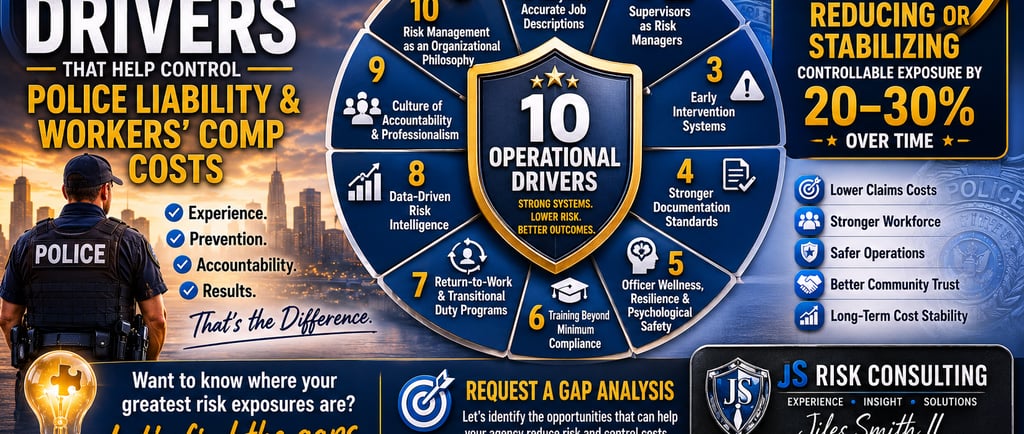
The 10 Operational Drivers That Help Control Police Liability and Workers’ Compensation Costs
By Jiles Smith II
After more than 37 years working in risk management across multiple jurisdictions, municipalities, and public agencies, I have consistently observed that law enforcement agencies that intentionally focus on several core operational areas are often better positioned to stabilize and reduce liability and workers’ compensation costs over time.
While every agency faces unique operational, staffing, political, and community challenges, agencies that proactively invest in prevention, supervision, wellness, documentation, training, and accountability often experience measurable improvements in claims outcomes and overall cost control.
In many cases, I believe agencies can reduce or stabilize controllable exposure by 20–30% over time when these operational strategies are implemented consistently and supported by leadership.
The claim rarely starts at the time of injury.
The lawsuit rarely starts with the lawsuit.
The exposure often begins years earlier through organizational drift, inconsistent supervision, poor communication, weak systems, lack of accountability, and failure to address warning signs early.
Based on years of experience working alongside public agencies, these are the operational areas I believe most directly influence police liability and workers’ compensation outcomes.
1. Conduct Functional Job Analyses and Maintain Accurate Job Descriptions
One of the largest drivers of preventable claims exposure is the disconnect between actual job duties and documented job expectations.
A comprehensive functional job analysis helps agencies:
Establish defensible essential job functions
Improve return-to-work decisions
Reduce accommodation disputes
Clarify fitness-for-duty expectations
Improve hiring and training alignment
Without clear job expectations, agencies often lose consistency in accountability, medical management, and return-to-work processes.
2. Create a Culture Where Supervisors Understand They Are Risk Managers
Frontline supervisors often become one of the strongest predictors of future claims exposure.
Supervisors influence:
Documentation quality
Morale
Accountability
Communication
Injury reporting
Officer conduct
Early intervention efforts
Poor supervision creates inconsistency, and inconsistency often creates liability.
3. Develop Early Intervention Systems Before Employees Reach Crisis
Many catastrophic workers’ compensation and liability claims show warning signs long before the major event occurs.
These signs may include:
Attendance deterioration
Increased complaints
Emotional exhaustion
Anger escalation
Performance decline
Isolation
Stress symptoms
Repeated minor injuries
Effective organizations create structured early-intervention systems focused on support, accountability, wellness, and documentation before an employee reaches operational or emotional failure.
4. Improve Documentation Standards Throughout the Organization
Weak documentation quietly drives millions in avoidable exposure.
Documentation failures commonly affect:
Performance counseling
Use-of-force reviews
Training records
Injury investigations
Accommodation discussions
Return-to-work efforts
Policy enforcement
Good documentation is not about punishment.
It is about consistency, fairness, organizational memory, and defensibility.
5. Invest in Officer Wellness, Resilience, and Psychological Safety
Unchecked trauma exposure may contribute to:
Burnout
Stress claims
Poor decision-making
Aggressive interactions
Depression
Early disability retirement
Retention issues
Wellness programs should not begin only after a critical incident. High-performing organizations normalize resilience training, peer support, decompression strategies, mental health access, and trauma-informed leadership before personnel reach crisis points.
This is not simply a wellness issue.
It is also a long-term operational risk management strategy.
6. Strengthen Training Beyond Minimum Compliance Requirements
Many agencies unintentionally treat training as a compliance exercise instead of a long-term risk reduction strategy.
Training should be reinforced:
Decision-making under stress
Communication skills
De-escalation
Report writing
Tactical restraint
Emotional intelligence
Documentation consistency
Training must become operational behavior, not merely attendance records.
7. Build Strong Return-to-Work and Transitional Duty Programs
One of the most overlooked financial exposures in policing is prolonged absence from work after injury.
Agencies that fail to create meaningful transitional duty opportunities often experience:
Increased indemnity costs
Extended disability durations
Employee disengagement
Loss of institutional knowledge
Increased retirement exposure
Employees who remain connected to the workplace often recover more successfully than employees isolated from the organization for extended periods.
8. Use Data to Identify Patterns Before They Become Catastrophic
Too many agencies only review claims after major losses occur.
Modern risk management should analyze the following:
Injury trends
Near misses
Complaint patterns
Vehicle incidents
Overtime fatigue
Supervisor trends
Stress-related absences
Training gaps
Repeat claimants
The goal should be prediction and prevention, not simply reporting.
9. Align Organizational Culture with Accountability and Professionalism
Operational culture directly impacts frequency and severity.
Agencies that tolerate:
Cynicism
Inconsistent discipline
Poor communication
Leadership avoidance
Toxic work environments
Informal rule systems
Will often eventually see those issues reflected in workers’ compensation claims, lawsuits, retention problems, internal complaints, and disability retirement filings.
Culture eventually becomes measurable financially.
10. Stop Treating Risk Management as a Department Instead of an Organizational Philosophy
One of the biggest mistakes agencies make is believing risk management belongs only to the risk manager.
Effective risk control requires collaboration between:
Police leadership
Human resources
Labor relations
Legal counsel
Training units
Wellness teams
Claims administrators
Supervisors
City leadership
Risk management is not a silo.
It is an operational philosophy that should influence hiring, supervision, training, communication, wellness, and organizational decision-making.
Closing Perspective
After decades of working with public agencies, I have come to believe that liability and workers’ compensation exposure in policing is rarely random.
Most major losses can often be traced back to operational decisions, leadership practices, communication failures, cultural issues, or organizational blind spots that existed long before the incident occurred.
The agencies that consistently manage costs more effectively are usually not the agencies with fewer challenges. They are often the agencies that intentionally build systems focused on prevention, accountability, resilience, communication, professionalism, and operational consistency.
In many ways, the future of police risk management may depend less on defending claims and more on understanding why the claims developed in the first place.
For agencies interested in evaluating operational blind spots, claims trends, supervision systems, wellness initiatives, return-to-work practices, or organizational risk drivers, a structured gap analysis may help identify opportunities for improvement, consistency, and long-term cost stabilization.
Sometimes the greatest organizational risks are not the ones we see immediately, but the ones that slowly become normalized over time.
JS Risk Consulting works with agencies to help identify operational gaps that may contribute to preventable exposure, organizational strain, and rising claims costs.